
Have you ever wondered how to layer necklaces so they complement one another? You put on two and they hang at nearly the same level, so one keeps sliding over the other and together they look messy. You try another combination; a few minutes later you take everything off and leave wearing one. The good news is that good layering is a process and here is the guide.
How do I choose the lengths?
Step 1 – Start with the piece you want to wear.
Choose the necklace you most want to wear that day. It becomes the base of the combination and the other choices follow from that.
Step 2 – Space the layers 5-10 cm (2-4 inches) apart.
Jewellers broadly agree on this range, for two reasons:
- Each necklace sits at a visibly different level, so the combination looks intentional.
- Chains sitting at the same length move together and twist around each other. Spacing them apart reduces tangling.
If the first piece sits at 40 cm, the next works at around 45 and the one after at 50 or 55.
Step 3 – Put them on shortest to longest.
Fasten the shortest necklace first, then each longer one in turn. Each piece settles into position before the next is added, and the clasps stay in order at the back of the neck, which makes the set easier to take off later.
Step 4 – Keep the longest at an everyday length.
Around 60 cm (24 inches) is a practical maximum for daytime. Longer pieces swing when you lean forward and catch on desk edges and bag straps. Save lengths beyond that for evenings.
Step 5 – Adjust for the neckline.
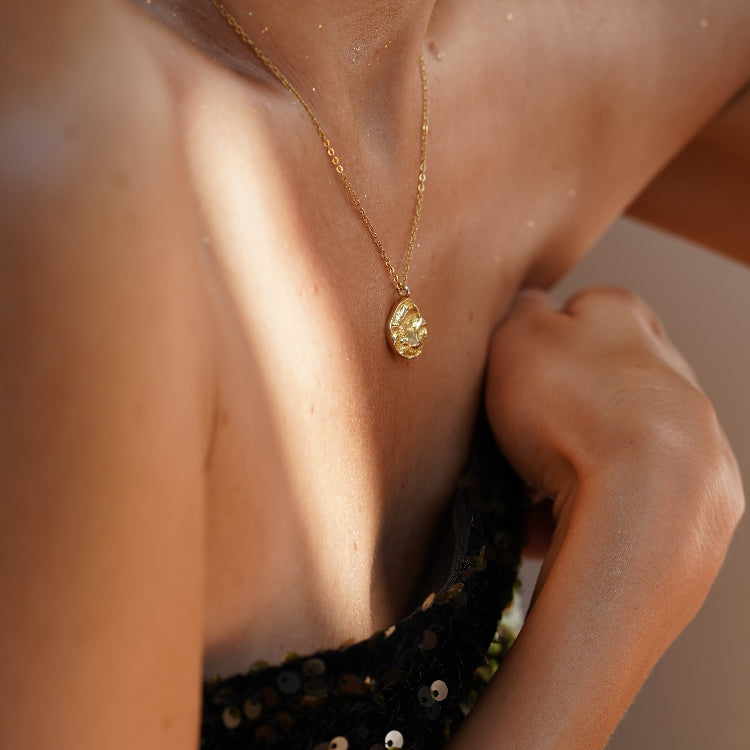
Open or low neckline – the layers sit on skin. Place the shortest at the collarbone and let the rest fall inside the neckline, following its shape.
High or closed neckline – wear the layers over the fabric. Longer lengths work better here, because they show clearly against the fabric while short pieces sit close to the collar and are harder to see.
"From the 1920s, Gabrielle Chanel layered pearls, chains and charms together and wore her fine jewellery beside faux pieces, at a time when costume jewellery was considered a faux pas in polite wardrobes."
Do all materials go together?
Broadly, yes. It really depends on your preference. We say: materials go together when you decide they do.
The mixing itself has a long pedigree. From the 1920s, Gabrielle Chanel layered pearls, chains and charms together and wore her fine jewellery beside faux pieces, at a time when costume jewellery was considered a faux pas in polite wardrobes. By 1929 she was offering necklaces of coloured beads combined with chunky wooden chains. So beads worn with chains has nearly a century of elegance behind it.
The question is less whether materials can be combined and more what kind of look you are building.
Step 1 – Start with the piece you want to wear.
The same principle as with lengths. The anchor's material sets the direction for what joins it.
Step 2 – Choose the look you are going for.
For contrast
Contrast means each piece stays readable on its own – the eye can tell where one necklace ends and the next begins. For contrast you can:
- Mix materials. Beads with a fine chain, pearls beside gold, a pendant against plain chains, or natural materials – wood, stone, shell alongside metal. The pairing works because each element gives the other a background.
- Mix metal tones. Gold with silver works as deliberate contrast. Let one tone lead and use the other as the accent, and repeat the accent somewhere – a second necklace, or earrings – so the mix reads as chosen.
- Mix colour. Coloured stones or beads against plain metal bring the liveliest version of contrast. A palette of two or three colours holds together well; the plain chains give the colour room to stand out.
"Coloured stones or beads against plain metal bring the liveliest version of contrast. A palette of two or three colours holds together well; the plain chains give the colour room to stand out."
To build one statement
Layer several pieces from the same material family – all gold, all silver, all pearl – and vary only the weight and structure: a chunky chain, a mid-weight one, a fine one. Worn together, they read as a single substantial piece rather than three separate necklaces. The repetition of material is what fuses them; the variation in weight is what gives the piece its depth.
Mix textures within one material. A smooth chain against a textured one, or matte beside polished. The metal stays the same and the surfaces do the contrasting – a subtler version of the same idea.
One practical note that serves both looks: vary the weight of your chains. Chains identical in weight and structure swing in sync, twist around each other and tangle. Chains of different weights move at different rhythms and largely leave each other alone.
How many necklaces is too many?
Two or three covers most days. Three gives the look depth while staying quick to put on; beyond four, the layers start competing for the same stretch of neck and dressing takes longer than it should. If you are unsure, start with two and add a third or fourth when the combination feels settled.
What do I do when they tangle anyway?
Physics is on the side of the knot. But there might be help for you out there. Try using a necklace layering clasp (sometimes called a necklace separator or detangler). These clever little clasps let you attach each chain separately, reducing twisting and tangling throughout the day. They are especially handy when you are layering necklaces of similar lengths or delicate chains that tend to get caught together.
If it still happens:
- Unclasp everything first. An open chain releases far more easily than a closed loop, and the extra slack does half the work.
- Work from the centre of the knot outward, on a flat surface, with a pin or a needle. Pulling the ends only tightens it.
- Store the pieces separately afterwards. Hang them individually or clasped and lay flat.
Layering is a method more than a talent: an anchor piece, a little space between the layers and materials chosen on purpose. The rest is preference – and preference is the part you already have.